Multi-quantity and multi-item eBay orders
How ProfitClerk records an eBay order for several units of one item, or several different items bought together, and how fees, postage and refunds are split.
One item bought several times (a multi-quantity sale) is a single order line in ProfitClerk with its quantity, so its item cost is the units × the unit cost. Several different items bought together (a multi-item order) is split into one line per item, each with its own item cost and profit; the order's fees, eBay label cost and refunds are shared between the lines by their share of what the buyer paid.
Multi-quantity sales
A buyer who buys 3 of the same listing gives you one order line with Qty 3.
- Sale (the gross sale) is what the buyer paid for all 3, including their postage.
- On the order's page, Unit price is the gross sale ÷ the quantity.
- Item cost is 3 × the unit cost, shown in the note, for example "3 × 2.5000 (Average)".
- Three units come off the matching stock item.
- ROI and Margin are worked out on the whole line.
When stock runs short
If the sale needs more units than your recorded stock has left, it still comes in. The units beyond your stock are costed at the item's average cost and the item cost is tagged Estimated. Restock the item so later sales have stock to draw from, and correct this sale with Edit in the cost column if you know its real cost. See cost confidence.
Multi-item orders
When a buyer checks out several different listings at once, eBay makes one order with several items. ProfitClerk stores each item as its own order line:
- Each line has its own row on Orders and its own page.
- Each line is matched to stock by its own SKU, so each gets its own item cost.
- The line's reference is the eBay order number followed by a dash and eBay's line number.
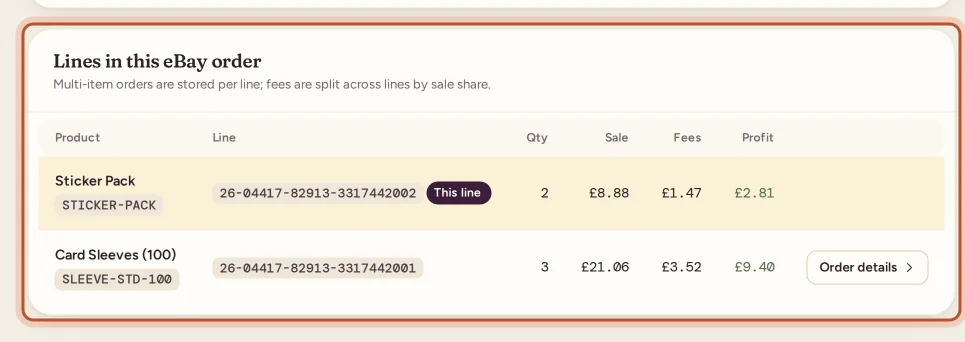
On any line's page, Lines in this eBay order lists every line of the order, with This line marked and a link to the others.
How shared amounts are split
Some amounts belong to the whole eBay order rather than to one item. ProfitClerk shares them across the lines by each line's share of what the buyer paid:
- eBay fees, including fee credits;
- refunds;
- the eBay Labels cost of the order.
The last line takes any odd penny, so the lines always add up exactly to the order's totals.
Postage charged is taken from each line as eBay reports it.
An example
A buyer buys a 30.00 jacket and a 10.00 scarf in one order (40.00 in all). eBay's fees on the order come to 6.00 and you buy one 4.00 label.
| Line | Share | Fees | Label |
|---|---|---|---|
| Jacket | 75% | 4.50 | 3.00 |
| Scarf | 25% | 1.50 | 1.00 |
Each line then takes off its own item cost. These numbers are made up to show the split.
Your own costs per line
- Label and packaging: set them on each line's page under Label and packaging. If you typed a label cost for the whole parcel, enter it on one line and leave the others at 0, or split it as you like, so it is not counted twice.
- Item cost: set per line with Edit or Add cost.
- Returns: record them on the line of the item that came back.
Reports and counts
- The Orders list counts order lines, so a 3-item order shows as three rows.
- Breakdowns by category, brand or label use each line's own stock item, so a mixed order lands in the right groups.
See how profit is calculated for the sum on each line.
Questions people ask
Why does one eBay order appear as several rows on Orders?
The buyer bought different items in one checkout. Each item is its own order line, so each gets its own item cost and profit, and its own page.
How are eBay fees split between the items of one order?
By each line's share of what the buyer paid. A line that is 75% of the order's value carries 75% of its fees, and the lines always add up to the order's total.
What happens if I sold more units than I have in stock?
The sale still comes in. Units beyond your recorded stock are costed at the item's average cost and the item cost is tagged Estimated until you restock or correct it.
Can I record a return for just one unit of a multi-quantity sale?
Yes. In Record a return, set Units to the number that came back. You can keep recording returns until every unit has one.
Thanks for telling us.