Margin, ROI and days to sell explained
What profit margin, ROI and days to sell mean in ProfitClerk, how each is worked out from your eBay sales, and where to see them for an order or a product.
Margin is your profit as a share of what the buyer paid. ROI (return on investment) is your profit as a share of what the item cost you. Days to sell is how long the stock sat between buying it and selling it. ProfitClerk shows all three for every sale and for every product.
The three figures
| Figure | Sum | Tells you |
|---|---|---|
| Margin | Net profit ÷ gross sale | How much of each sale you keep |
| ROI | Net profit ÷ item cost | How hard the money you spent on stock works |
| Days to sell | Date sold − date bought | How quickly stock turns back into cash |
The net profit is after every cost: eBay fees, label, packaging, item cost, return postage and refunds. See how profit is calculated.
An example
A buyer pays 20.00 including postage. After fees, postage and packaging, and an item cost of 5.00, your net profit is 8.00.
- Margin: 8.00 ÷ 20.00 = 40%
- ROI: 8.00 ÷ 5.00 = 160%
You bought it on 1 March and sold it on 15 March: 14 days to sell.
Margin can never go above 100%, but ROI can: an item bought for very little and sold well shows a high ROI. Both are negative when the sale made a loss.
Where to see them
On a sale
On an order's page, three figures sit under the headline numbers: ROI ("Profit ÷ item cost"), Margin ("Profit ÷ sale") and Days to sell ("Bought … sold …").

On Orders, the ROI · days column shows the same for each line. In the app, the sale's profit card shows the margin, ROI and days as pills, and each sale in the Sales list carries tags such as ROI 160% and 14 d.
On a product
On Inventory, the ROI and Days to sell columns give each product's figures over all its sales. Open a product to see How it sells:
- Units sold
- ROI: profit ÷ item cost, over sales with a cost
- Margin: profit ÷ sales, over sales with a cost
- Avg. days to sell, with the fastest and slowest sale
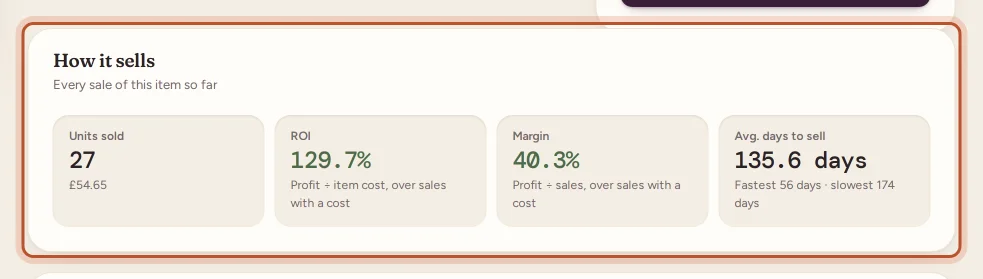
The app's stock item page has the same How it sells panel.
For a period
Overview and the reports show the margin of all sales in the period. See profit and loss for the full picture with expenses.
When a figure shows a dash
- No item cost: margin and ROI need an item cost. Without one the profit leaves out what the item cost you, so the order shows Needs an item cost. See sales with no item cost.
- Item cost of zero: ROI cannot divide by zero, so it shows a dash. Margin still works.
- Purchase date unknown: days to sell needs the date the stock was bought. Sales that matched no stock item have none.
How days to sell is worked out
When a sale takes units off a stock item, ProfitClerk notes when those units were bought: the Date bought you entered when you added or restocked them (or the day you added them, if you left it empty). It uses the oldest units first, the same order as FIFO. Days to sell is the time from that date to the sale.
Which one to watch
- Margin is good for comparing sales and periods: is each sale still worth the effort after eBay's fees and postage?
- ROI is good for buying decisions: which kind of stock earns the most back on what you spend?
- Days to sell shows where money sits on the shelf. A high ROI that takes a year to arrive can be worth less than a modest one in a fortnight.
Questions people ask
What is the difference between margin and ROI?
Margin compares profit with what the buyer paid; ROI compares profit with what the item cost you. A cheap item that sells well can have a modest margin and a very high ROI.
Why does an order show a dash instead of ROI or margin?
The sale has no item cost, so its profit is overstated and the figures would mislead you. ROI also needs an item cost above zero. Add the cost and both appear.
Is the postage the buyer paid part of the margin?
Yes. Margin is profit divided by the gross sale, which includes the postage charged.
Where does the purchase date for days to sell come from?
From the Date bought you entered when adding or restocking the stock the sale used. If you left it empty, it is the day you added the stock.
Does the cost view change margin and ROI?
Yes. Both use the sale's profit and item cost in the cost view you chose, average or FIFO.
Thanks for telling us.